Madras, 15 November 1950
The Baby Hindustan
The first motor car ever assembled in Madras was a Morris Minor. It is one of the odder facts in Indian motoring history, and almost nobody knows it.
Smith Road, 1950
Addison & Company, part of the Amalgamations Group, was the Indian agent for the Nuffield Organization — Morris, Wolseley and Riley — as well as for Chrysler's Plymouth, Dodge and De Soto. On 15 November 1950, a Morris Minor was driven out of Addison's twin plants on Smith Road by S. Anantharamakrishnan.
It was the first Morris Minor assembled in India. It was also the first car of any make assembled in Madras — the beginning of an industry that now makes the city one of the largest vehicle manufacturing centres in Asia.
Hindustan Motors and the Baby
Hindustan Motors had been founded in 1942 by B. M. Birla, and its relationship with Morris was the foundation of the company. Its first product, the Hindustan Ten, was based on the Morris Ten Series M. The Morris Oxford MO followed as the Hindustan Fourteen.
In the early 1950s Hindustan extended the arrangement and began building the Morris Minor in India. They renamed it for the local market, and the name they chose has stuck in the memory of everyone who grew up around one: the Baby Hindustan.
It sold well. And the same partnership carried on: the Morris Oxford Series II became the Hindustan Landmaster in 1957, and the Series III became the Ambassador — which stayed in production until 2014 and became, for half a century, the default Indian car.
So the Minor is not a curiosity that happened to wash up here. It sits at the start of the line that produced the Ambassador.
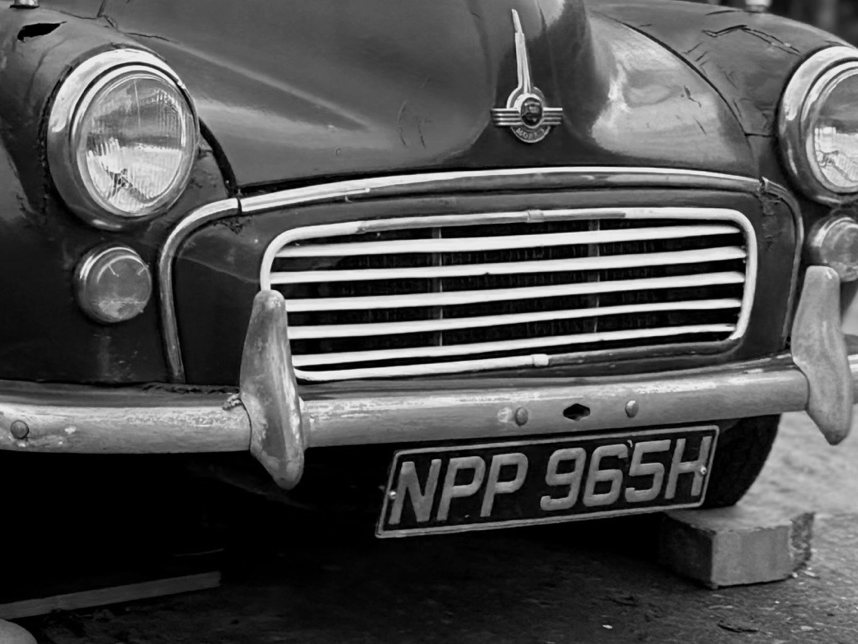
The Indian line
Why it matters if you are buying
A Morris Minor in India is not an import curiosity. It is a piece of the country's own motoring story — and the survivors, properly restored and still on their original registration, are now genuinely scarce.
Where they all went
Minors were cheap, tough and easy to fix, which is exactly why so few good ones survive. They were not collected; they were used. They did school runs and office commutes through the fifties and sixties, were handed down, patched up, re-bodied by local workshops, and eventually left in a shed or sold for scrap when parts got hard to find and the Ambassador got cheap.
What survives today falls into roughly three groups:
- Cars that were restored properly, usually in the 1990s or 2000s when interest in vintage motoring revived in Delhi, Bombay and Calcutta, and which have been maintained since. These are the ones worth buying.
- Cars that were repainted, which look presentable in photographs and are structurally tired underneath.
- Projects — genuinely rusty, incomplete, and far more expensive to bring back than their asking price suggests.
The gap in value between the first group and the second is much wider than most sellers admit, and it is almost entirely about metal and paperwork rather than how shiny the car looks.
How scarce is scarce?
There is no register of surviving Morris Minors in India, so nobody can give you a real number. What can be said is what the market shows: at the time of writing, the major Indian used-car portals between them list one or two Morris Minors for the entire country, and vintage cars of this kind mostly change hands privately, inside clubs and rally circles, without ever being advertised at all.
That is the practical reality. If you want one, you will probably wait, and you will probably hear about it through someone rather than find it in a search.
The clubs
If you are serious about these cars, the vintage movement in India is where the knowledge and most of the good cars are. The Statesman Vintage & Classic Car Rally in Delhi is the oldest and best-known event of its kind in the country, and the Heritage Motoring Club of India and the regional clubs in Bombay, Calcutta, Bangalore and Hyderabad are where owners actually find each other.
Going to one is worth more than a month of scrolling through classifieds.
Cowley or Calcutta?
One question worth asking of any Indian Minor is where it was actually built. A car assembled here by Hindustan Motors or Addison's is a slightly different object from one shipped complete from Cowley, and for some collectors the Indian-built car is the more interesting of the two.
Honest answer: it is often impossible to tell without the chassis records, and many owners have never chased them down. Nobody should claim a car is Indian-assembled without something to back it up — and equally, nobody should discount one for lacking the paperwork.
The Minor 1000 currently listed on this site falls into that category: a genuinely old car with continuous ownership since 1999, whose build origin has not been formally traced. See the car, its photographs and its condition →
Next: buying one in India
Values, rust, parts, vintage registration and the Delhi-NCR rules explained.
Buyer's guide →The full history
Issigonis, the Mosquito prototype, Earls Court 1948 and the three series.
1948–1971 →One car available
A Morris Minor 1000 in Gurgaon, in one family since 1999.
See the listing →